


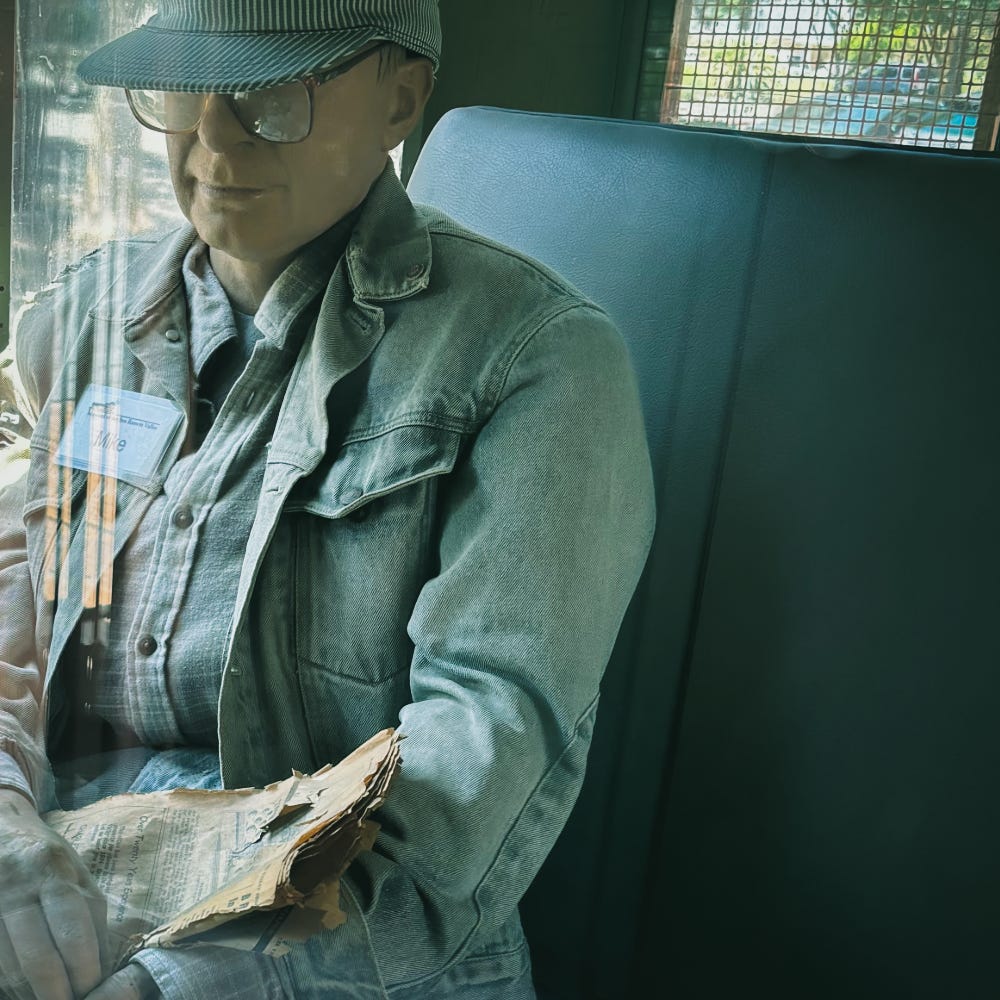
The men in painted-on hats and coveralls jackhammered whenever the train rolled by. It was a neat trick. Like the truck loading logs. Like the sawmill cutting wood.
The old man with gray tufts of hair jutting from his earholes didn’t smile. But he was in his element. He would be running trains with or without guests. He brought the black throttle down with the care of a lover, halting his ebony train at the station on a cloud. A second later, he flicked a metal toggle labeled 2, and then moved the throttle back up, letting loose his circus train from the same station his ebony engine cooled. Its whistle blew for Ren, who ran alongside the track hooting at the tigers, orbiting the oblong table like a monkey on a leash.
I smiled a ragtime smile. I longed to lounge in the gazebo with a mint julep, and throw bread to the glossy mallards in the pond. I wanted to hear the rosy-cheeked band, frozen in jubilance, play for passengers coming and going and going and coming, always and forever.
The world made sense: there was pancakes that morning, the paper was on time, I stubbed my toe, we marveled at the tomato plant’s yellow flowers, and how some of them had finally fallen away, replaced by tiny green globes. June went to the parlor. Ren and I went up the block to the train museum.
I followed Ren who followed the train. Around and around, until I was a passenger, watching from the window of the passenger car. Until I was the mayor, hollering in the middle of the flag-lined Main Street.
The sound of the train whistle jarred me loose from my resin dreams. I looked around, but Ren was gone. I asked the old man if he saw where he got off to.
“What?”
“Did you see a little boy wearing a red cap?”
He turned his ear toward me. “What?”
Out on the street, the heat chewed all. Ragged men and women scuttled about to the nearest shop for a hit of AC. I ran down to the parlor—June was looking at a magazine. I popped my head in the door and felt the cool air threaten me. “Ren?”
“What?”
“Have you seen Ren?”
“What?”
I ran down the street hollering. Ran past the diner, back to the train museum.
“He come back? The boy with the red cap?”
“What?”
The police came. People on the street helped—good people. Good people who wanted to be heroic. Good people who didn’t save anyone. Good people who would shake their heads over the years and say, “What could have happened to that boy I just don’t know.” And then cut the turkey. Then drink the eggnog. Then light the sparklers. Then open gifts. Then fuck and—if there was a war on—kill or die or both. “What could have happened to that little boy?”
June drank herself to death.
“I just don’t know.”
Each summer I visited the museum to look for Ren. But the trains were slower. The painted hats, chipped. The man with the tufts of gray in his ears, dead. They hung a picture of him over the museum door like Christ.
Bob Smith, Engineer. INRI.
It’s a minute-melt popsicle day. Doug’s Saloon has a stiff one just for me. Ding Ding Ding. The light turns red. The arm comes down, I consider going around, but I chicken out. As the train growls and hisses past me, I see happy people in the passenger car windows. They’re on their way to happy places. And I need that stiff one. The tracks rattle my head.
But then I see a flash of red: Ren’s hat. And it isn’t just his hat, I see his face. And it isn’t just his face, I see his smile—I see my son. A sob rattles my ribs.
I jam my foot on the pedal and follow the engine for miles, crying and shouting and praising god with snot and tears and—hallelujah! I’ll make him his favorite supper: frank n’ beans. I’ll buy him all the trains and cars and planes he wants and—hell—we’ll live on a train if that’s what he wants. We’ll live on a train and work the tender. We’ll eat in the dining car and pet the lions and tigers and bears—oh my!
The train stops at a station just before a tunnel. The station has no name, a small white building with a blank sign like a wooden tooth hanging from rusty roots. The train doors open for me.
I push past the ticket man, running down the aisle, calling Ren’s name.
“Ren! Ren, it’s me! It’s daddy, Ren! It’s your dad! I never forgot about you, buddy! I never gave up!”
The doors shut, and I see them. All of them. Plastic with painted-on clothes. A plastic world in medias res; waving, running, singing, hollering.
And outside, Ren is running alongside the train, following, laughing. A monkey on a leash.
And I’m swallowed.

Psst! Paid subscribers to Automatic Writer get access to all current and past posts, plus the occasional goody. (Zines, books, stickers, music, additional content, etc.) And because I’ve learned I’m never satisfied with anything unless I’m giving a portion back to the community, 50% of the proceeds from your subscriber moola goes straight to InsideOUT Writers, a non-profit organization dedicated to reducing recidivism by providing services to young people navigating juvenile detention and life after incarceration.
all is quiet in the desert. (Pt. 1)

He’s doing laps, tan arms sculling the water, lips sucking and blowing air. I consider ending it now. I could shoot him. Me, a harpoon. Him, a bronzed whale. Chum up the water. But for now, I’m not a harpoon, only a man on his way to California for a business meeting. Nothing more.

Beneath the Valley Oak

This story was originally published in Beneath the Valley Oak, a collection released by Spare Press, an imprint of Spareorgan. If you’d like the full collection, you can get the print edition here (recommended): spareorgan. Or the ebook here: Amazon.
Maybe this might be horror, but it reads a lot like the heartbreak of loss to me. The way you wrote it, with people wondering, “What could have happened to that little boy?” between each symbol of a passing holiday, and with the single quiet sentence stating simply that Ren's mother drank herself to death... so much pain distilled into so few words. This is very, very good.
No closure. Wasn’t ready for that 💔 but I shouldn’t trust you not to hurt me. Nice shot, btw.